Frank Kendall, secretary of the US Air Force, speaks during the US Chamber of Commerce’s Global Aerospace Summit in Washington, DC, US, on Tuesday, Sept. 10, 2024. (Ting Shen/Bloomberg via Getty Images)
AFA 2024 — As the US Air Force goes back to the drawing board to decide what it wants from its much-anticipated next-gen fighter jet, the Air Force secretary revealed today the plane may not be called on to play quarterback for a coterie of loyal wingman drones as originally envisioned.
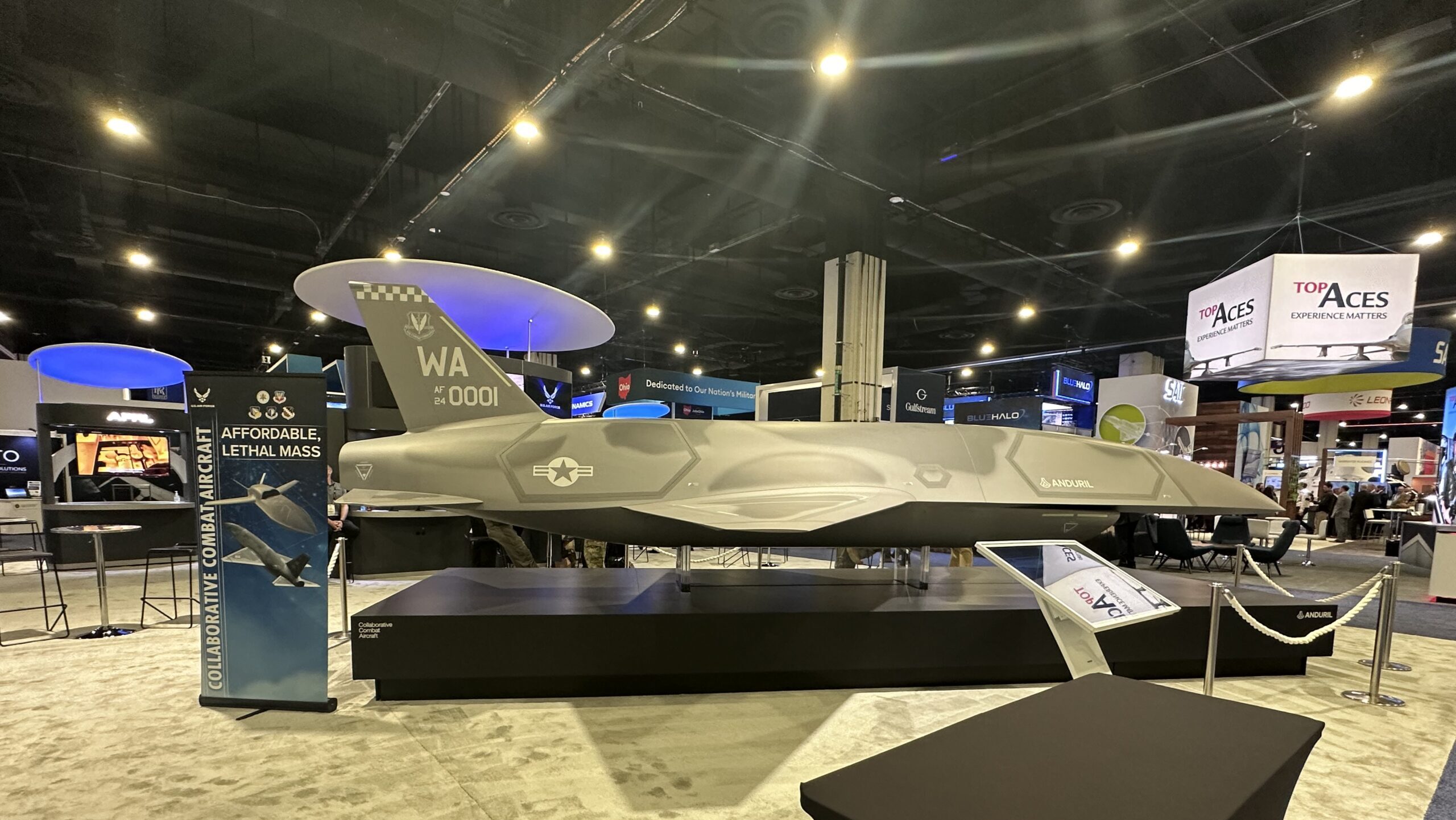
Frank Kendall said that while his service is “moving towards greater reliance on uncrewed aircraft,” it was a “question mark” as to whether the Next Generation Air Dominance (NGAD) fighter would control the Collaborative Combat Aircraft (CCA) drones.
Kendall made the remarks at a roundtable at the Air and Space Forces Association Air, Space & Cyber annual conference here in Washington, where last year he described NGAD and CCA in terms that suggested nearly intertwined programs — with aircraft numbers based in relation to one another. CCAs were also envisioned operating with current fighters like the F-35.
But since then the Air Force has paused development of NGAD and reexamined basic assumptions about the aircraft — even, apparently, absolute certainty it would have a human pilot on board. (“We’re probably going to do one more version, at least, of crewed, more traditional aircraft,” he said today.)
Kendall did say that any fighter jet controlling CCAs would be manned, noting “I don’t see us going away from that combination anytime soon.”
Kendall also revealed new details about how CCAs, expected to be fielded before the end of the decade, will operate. He said the Air Force previously envisioned a single fighter controlling roughly three-to-five CCA drones, but the service is “talking about bigger numbers than that now.”
The secretary also has previously told Breaking Defense the Air Force is still working out thorny ethical issues associated with employing the drones, and explained today that some operational limits should be expected as a result.
“One of the things you have to have if you’re going to use CCAs and have them be armed and lethal is that they have to be under tight control. And for me, one of the elements of that needs to be line-of-sight communications,” Kendall said. Line-of-sight communications refers to direct links between a transmitter and receiver without obstructions like the curvature of the earth.
“We’re not going to have aircraft going out and doing engagements uncontrolled, so the default, if they lose communications, would be for them to return to base, which takes them out of the fight,” he continued. “So we don’t want that to happen. And when they do do engagements, we want them under tight control.”
NGAD Cost
While work on NGAD remains stalled, Kendall said today a decision on what to do with the fighter should be reached within the next few months, despite numerous variables that officials have to weigh.
One key factor officials have to balance is price, as more expensive options could prevent the service from fielding the fighter in sufficient numbers. Kendall today doubled down on aiming for a cost target roughly in the ballpark of an F-35, arguing that — assuming NGAD does, in fact, control loyal wingmen — “once you start integrating CCAs and transferring some mission equipment and capabilities functions to the CCAs, then you can talk about a different concept, potentially, for the crewed fighter that’s controlling them.”
Air Force acquisition chief Andrew Hunter stressed in a later roundtable with reporters today that the service is “looking for an affordable design concept” for NGAD that in turn would enable the jet to be fielded “in sufficient numbers.” Hunter conceded that it’s possible the cost target can’t be reached, though he emphasized that analysis has to finish first. And, Kendall said, the Air Force will field the fighter even if a more expensive option proves to be the most cost-effective.
A team of advisors led by Tim Grayson, a special assistant to Kendall, is looking at the NGAD platform in a wider context to include the role for a next-gen tanker and future tranches of CCA, Kendall said. Yet even after all of those questions are settled, underlying technological concerns may not be the biggest challenge.
“Then by the way, we’ve got to figure out how we’re going to pay for it, which I think may, at the end of the day, be our biggest problem,” Kendall said.
PHOTOS: AFA 2024

 Gallery




Breaking Defense Video