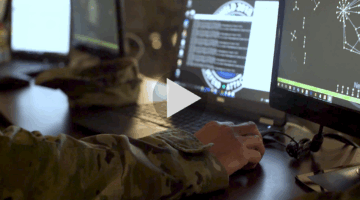
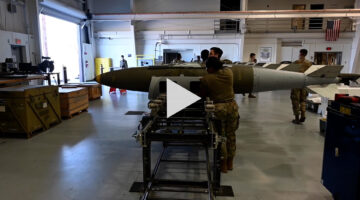
The Navy is the leading practitioner of live, virtual, and constructive training in the DoD, and HII has a strong history of developing LVC solutions in support of the Navy. (Image courtesy HII)
SEA AIR SPACE 2023 — As the Navy looks at ways to keep its sailors training even halfway around the world at sea, it’s working on expanding what it calls its live, virtual, constructive (LVC) training systems onto ships, as well as integrating those capabilities into training for real-world command and control systems, according to a service official.
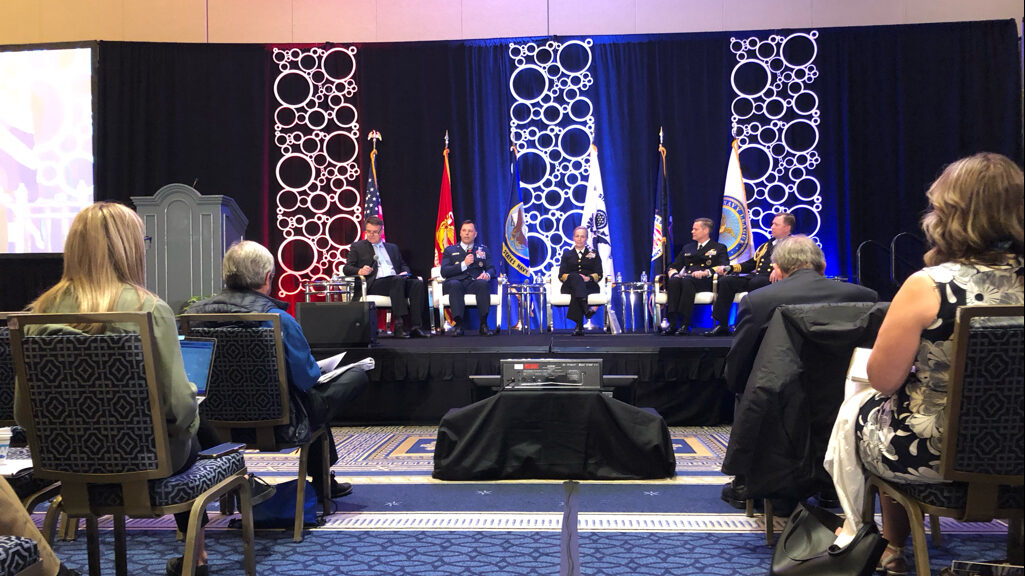
Rear. Adm. Andrew Loiselle, director of the Air Warfare Division in the Office of the Chief of Naval Operations, said on a panel here on Monday the goal is to give sailors the ability to train just about any time, anywhere.
“What we’re really trying to do with the entire architecture is move to a training-based system that takes us from an event-based system to a proficiency-based system,” Rear. Adm. Andrew Loiselle, director of the Air Warfare Division in the Office of the Chief of Naval Operations, said on Monday.
FULL COVERAGE: Sea Air Space 2023
The Navy has been building out its LVC training platform — a mix of real life scenarios integrated with virtual reality simulations — with prime contractor HII, including using its capabilities in its Large-Scale Exercise in 2021 and two Advanced Naval Technology Exercises in 2021 and 2022. The Army and Air Force are also using LVC training, but the Navy is the largest user.
Loiselle said the Navy wants a system that is no longer limited by land-based towers and would “give us the data capture and storage necessary to find individual operating performance on both the aircrew side and within our folks on ships as well.” Most of the ranges over land aren’t large enough to conduct training anymore, he explained.
To that point, the Navy is building out its Integrated Training Facility (ITF) and this year will begin integrating a “joint simulation environment” that includes F-35 simulations. The ITF is located at Naval Air Station Fallon, Nevada, and is in its initial operational capability. Loiselle added the Navy is also looking at ways to bring command and control capabilities onto its aircraft carriers to expand training in a move to “figure out a way to train at a larger distance than we are today.”
Integrating live data from the space and cyber domains into LVC training will also be critical for the military services as they push towards a software-first mindset rather than mainly focusing on hardware systems like in the past, according to Schyuler Moore, US Central Command’s chief technology officer.
Software is a “critical element of getting training done correctly” to get the right data into warfighters’ hands, but “that type of training is somewhat separate in many ways” from the LVC concept and data needs to be integrated from other domains, especially space and cyber data, she said.
“And so what I mean by that is that while you’re stimulating training with your hardware systems and with your particular scenarios that you might not be able to get in real life that are at the reps and sets that you need, integrating live data from those other domains is an increasingly critical piece to ensure that you’re getting a scenario that is realistic,” Moore said.
PHOTOS: Sea-Air-Space 2023

 Gallery











Breaking Defense Video