U.S. Secretary of the Army, Christine Wormuth arrives to preside over the investiture ceremony for Civilian Aide to the Secretary of the Army (CASA) Mrs. Noelani Kalipi (Staff Sgt. Nicholas J. De La Pena/US Army).
WASHINGTON: Facing anticipated tighter budgets, Army Secretary Christine Wormuth said she expects “continuity” for “big” modernization programs like the service’s future ground vehicles and helicopters, but that those too may not be free from constraints in the future.
“I’ll note that when you see the FY23 budget — which is going to get here, it may be a few more weeks, but I think we’ll see it — you’ll see a lot of continuity for those big programs,” Wormuth said at the McAleese Conference Wednesday. “But after a few years of initial work on FVL [future vertical lift] and ground vehicles, we’re reaching a point where obviously getting out into the mid- and far-years, the investments required are going to be very significant.”
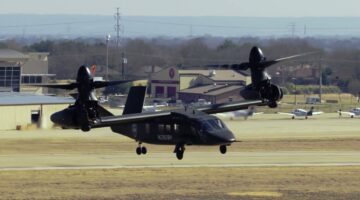
Wormuth was referring to specific Army programs such as the Optionally Manned Fighting Vehicle, Future Attack Reconnaissance Aircraft and Future Long Range Assault Aircraft, programs which won’t be fielded until the late 2020s.
Related: Army Acquisition Nominee Warns ‘Aggressive Timelines’ Could Cause Challenges For Prototype Efforts
However, those programs will have prototypes built in the next few years that Wormuth said would provide important feedback to inform future budgetary decisions.
“We’re going to gain both technical insights and also insights from a cost standpoint, as we start building real prototypes, doing flight tests, you know, essentially moving from working with computer models to real systems,” Wormuth said. “And that will help us understand how projected expenditures are going to solidify over the next couple of years.”
Those programs are part of the service’s massive modernization portfolio of 35 priority systems that the Army believes it needs on the future battlefield. The service boasts that 24 of those programs will be in some form of prototyping at some point in fiscal 2023.
The Army is facing tough budgetary decisions at the moment as the Pentagon shifts its focus to the capabilities it needs for any potential Indo-Pacific fight. The service wants to protect its modernization portfolio as it anticipates future budget slashes, but it also needs to maintain and update some of its older platforms, including M1 tanks, Bradley Fighting Vehicles or Apaches.
Related: From software to AR goggles: 4 takeaways from Army’s new acquisition chief
Deciding where to cut, however, is going to become harder and harder, as Wormuth said that most of the easiest cuts have already been made, save for a few “scrawny apples.”
“There’s not a lot of fruit left on the tree in that regard,” Wormuth said. “You know, there may be a few small, scrawny apples way up in the top that we can pick on. But I think, you know, the Army with three rounds of night court, you know, has largely looked already at what legacy systems we can move away from.”
It is also unclear how the service’s recent rapid deployments to Europe in response to Russia’s invasion of Ukraine could affect those decisions. Unplanned operations create additional fiscal strain on the service, and Wormuth told reporters after her speech that it is the service’s “strong view” that those need to be paid for by supplemental funding from Congress. She added that the Ukraine conflict won’t lead the service to make “significant changes” to the service’s modernization portfolio.
“We’re able, I think, to do what we need to do in terms of assuring allies with the forces we have now and the systems that we have now,” Wormuth said. “I think the kinds of roles and warfighting functions that we’re seeing are ones that we’ve anticipated with the modernization portfolios that we have. So I don’t see big changes at this point.”
Breaking Defense Video